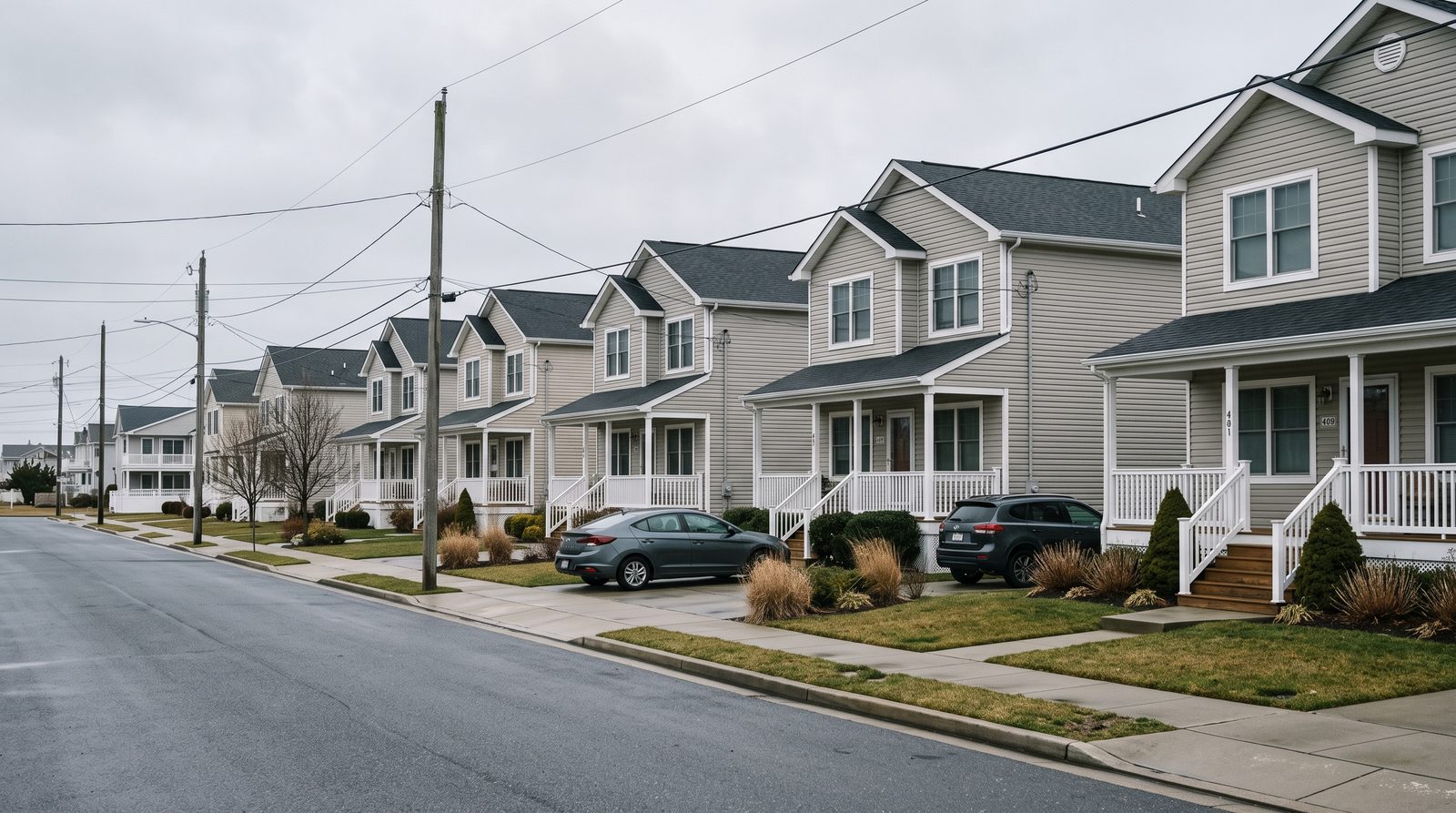
Do fifty town pages help local SEO?
Fifty near-identical town pages are not a sound local SEO strategy. Google calls pages targeted at regions or cities that funnel users toward one destination a form of doorway abuse. A town page can still be useful when it contains real jobs, local conditions, access details, photos, and answers that differ materially from every other page. If changing the town name leaves the page accurate, it is probably too generic.
This guide is for the owner of a power washing, lawn care, or other service business in Ocean County or Monmouth County, New Jersey. You are deciding whether to buy a large town-page package, rebuild a site that came with one, or fix pages that have not produced useful inquiries. The right decision is based on what each page helps a local customer do, not how many URLs appear on an invoice.
A useful page should answer a location-specific service question and lead directly to a usable next step, such as a relevant estimate form or phone path. A doorway page exists mainly to catch a similar query and move the visitor toward the actual useful part of the site.
Google's doorway policy names the pattern
Google's doorway abuse policy draws the important line for contractor town pages: pages created to rank for specific, similar searches are a problem when they act as less useful intermediate stops. Google says policy violations may cause pages to rank lower or disappear from results, so a page fleet should be judged by its purpose and usefulness before an owner approves it.
Google gives this example: "Having multiple domain names or pages targeted at specific regions or cities that funnel users to one page". The same policy also identifies substantially similar pages that sit closer to search results than a clear, browsable site hierarchy. A set of fifty service-in-town pages that all repeat the same pitch and send visitors to the same generic form fits the risk Google is describing.
Google's policy does not say that every page named for a town is spam. The issue is whether the page exists mainly to capture a query and funnel the visitor, or whether the page itself provides a useful destination. Google's scaled content policy adds a second warning when many unoriginal pages are generated primarily to manipulate rankings, regardless of whether a person, template, or AI produced them.
Can the page pass the substitution test?
The substitution test gives an Ocean or Monmouth County owner a concrete way to inspect a proposed town page before paying for volume. Copy the page into a document, replace the town with a neighboring town, and hide the title. Ask whether every remaining sentence, image, and answer still works without correction.
Next, mark every item that proves local knowledge: a real project, an original photo from the area, a route or access constraint, a verified local requirement, a response-time rule drawn from dispatch records, or a customer question that genuinely changes by location. Ignore sentences that only praise the company or repeat the town name. If the evidence column stays empty, the page has a name but no local substance.
The final pass is intent. A Jackson homeowner should be able to learn something about the service in Jackson and take the next step from that page without being pushed through another thin page. Google recommends original information, substantial value, and first-hand expertise; those questions are a better acceptance test than a vendor's promised URL count.
| Page | Doorway pattern | Genuinely useful version |
|---|---|---|
| Power washing in Manahawkin | The standard power washing pitch with Manahawkin inserted in the heading and a generic quote button. | Completed mainland job examples, area photos, surface and water-access notes, route coverage, and a clear statement about whether LBI calls are handled separately. |
| Power washing on Long Beach Island | The Manahawkin copy with Long Beach Island swapped in and the same travel promise. | Actual bayfront work, documented salt-air effects, the Route 72 crossing plan, summer arrival windows, parking instructions, and photos from island jobs. |
| Lawn care in Jackson | A statewide lawn-care paragraph followed by a long list of nearby ZIP codes and towns. | Jackson job examples, observed site conditions, services the route truly supports, route days, area photos, and answers drawn from local customer calls. |
Useful service-area pages are built from field evidence
A genuine service-area page for a Jersey Shore contractor is a compact field guide to buying that service in one place. It should identify work the crew actually performs there, show evidence from that area, explain meaningful constraints, and answer the questions that arise before an estimate. The writer needs input from dispatch records, job notes, photos, and the people who performed the work.
Manahawkin and Long Beach Island show why geography can earn separate treatment. NJDOT identifies the Route 72 Causeway as the connection between the mainland and Long Beach Island and specifically notes seasonal traffic delays. A mainland page can state its normal route days, while an island page can explain bridge and causeway travel, honest summer arrival windows, and the parking or property-access instructions a customer must provide.
Salt-air exposure can also change useful service content when the company has real observations to share. A power washing page for bayfront work might document how exposure changed the cleaning plan for a specific surface, while an inland Jackson page should describe the different conditions the crew actually found there. The page earns the distinction through job evidence, not by declaring that every coastal or inland property is the same.
Flood-zone and permit information belongs on a town page only when it affects the service scope, and the municipal process must be verified. Stafford Township offers property flood-zone determinations and current building requirements, while Long Beach Township directs owners to its Construction Office to determine required local, state, or federal permits. A contractor should link to the responsible office and avoid giving a blanket legal answer; this is information, not legal advice.
- Two or three completed jobs in the area, with the service, property context, and result described accurately.
- Original, permission-cleared photos from those jobs, with captions that say what the image proves.
- Route boundaries, realistic response windows, and bridge, causeway, parking, gate, or rental-access instructions that affect scheduling.
- Observed local conditions such as salt-air exposure, drainage, shade, irrigation, or sandy soil only where the crew's records support them.
- The current municipal source for a permit, flood, or property rule when the work can trigger it, plus the date it was checked.
- A location-specific estimate path that asks for the details needed to qualify the job without sending the visitor through another town page.
Why is the tactic still sold?
Page-count packages are easy to sell because volume is visible and simple to put on an invoice. A find-and-replace template is cheap to generate at scale, while interviewing crews, sorting job photos, checking routes, and verifying town information takes real editorial work. The owner sees fifty deliverables before seeing whether any one of them helps a customer.
A vendor offering town pages is not automatically acting in bad faith. Templates can provide a consistent layout, and a business may legitimately serve many communities. The protective question is how the vendor will turn that shared structure into distinct, supportable information instead of using town names as the only variable.
Vendor vetting should happen before the page count becomes a contract requirement. Use the broader buying prompts at /blog/questions-to-ask-nj-web-designer/ along with the town-page questions below. Ask to see the research workflow and acceptance standard, not a ranking promise.
- Show three planned town pages side by side and highlight the facts that cannot be reused on the others.
- Explain who will interview the owner, dispatcher, or crew and how job notes will reach the writer.
- Identify where every local photo comes from and how the business will confirm permission and location.
- State what happens when the business lacks enough evidence to support a separate page for a town.
- Define how calls, forms, and qualified estimates will be tied back to each landing page.
- Describe who checks local requirements and how a page will be corrected when those requirements change.
A measured recovery plan for fifty thin pages
The recovery plan for an NJ contractor with fifty thin town pages begins with an inventory, not a mass deletion. Some URLs may have relevant impressions, outside links, direct visits, calls, or useful job material that can support a better page. Removing everything overnight can discard that information and makes it harder to identify which change helped or hurt.
The audit should place every URL beside its service, town, Search Console data, tracked leads, links, unique copy, local photos, and verified job evidence. Group pages that answer the same customer need. The troubleshooting sequence at /blog/contractor-website-not-getting-leads/ can help separate a thin-content problem from weak traffic, a broken contact path, or poor lead qualification.
The action for each page should be keep and improve, consolidate and redirect, or remove without replacement. Keep only pages that can become useful destinations. Merge overlapping material into the closest relevant service or service-area page, then redirect an old URL to that specific replacement rather than sending every town to the home page.
The rollout should use small, documented batches with a record of changed URLs, redirects, dates, inquiries, and Search Console trends. Google lists consolidating several pages into one as a legitimate reason for a redirect, and its people-first guidance warns against removing lots of old content merely to make a site seem fresh. An owner who wants a second set of eyes can use /claim/ to request a practical review of the current site.
- 1. Inventory every town URL and export the evidence attached to it.
- 2. Group pages by the customer need they answer, not just by town name.
- 3. Select the few locations with enough jobs, photos, logistics, and questions to support a useful page.
- 4. Improve those pages and consolidate overlapping copy into the most relevant retained destination.
- 5. Add one-to-one redirects, update navigation and internal links, then check the changed group before moving to the next batch.
Frequently asked questions
Frequently asked questions about NJ contractor town pages usually come down to purpose, evidence, and cleanup risk. The answers below apply the same test whether an Ocean or Monmouth County owner is reviewing a proposal or repairing an existing site.
Are all contractor town pages doorway pages?
No. A contractor town page can be a useful destination when it answers a real local service need with first-hand job evidence, relevant logistics, original photos, and a direct next step. The warning signs are substantially similar pages created mainly to capture neighboring town queries and funnel every visitor to the same generic page.
How many town pages can an NJ contractor have?
Google does not provide a safe page count in its doorway policy. The practical limit is the number of locations the business truly serves and can support with distinct, useful evidence. Ten proven pages can make sense while two interchangeable pages can still fail the substitution test.
Should I delete duplicate town pages immediately?
No. First inventory performance, links, leads, local evidence, and the closest useful replacement for every URL. Improve the pages that deserve to remain, consolidate overlapping pages, apply relevant redirects, and make the changes in documented batches so the business can verify the result.
Can AI make fifty town pages unique?
AI can organize crew notes or help draft from verified facts, but varied wording does not create local substance. Generating many pages without original value can scale the same problem Google describes. Require the real job, photo, route, constraint, local source, and customer question before drafting a separate page.