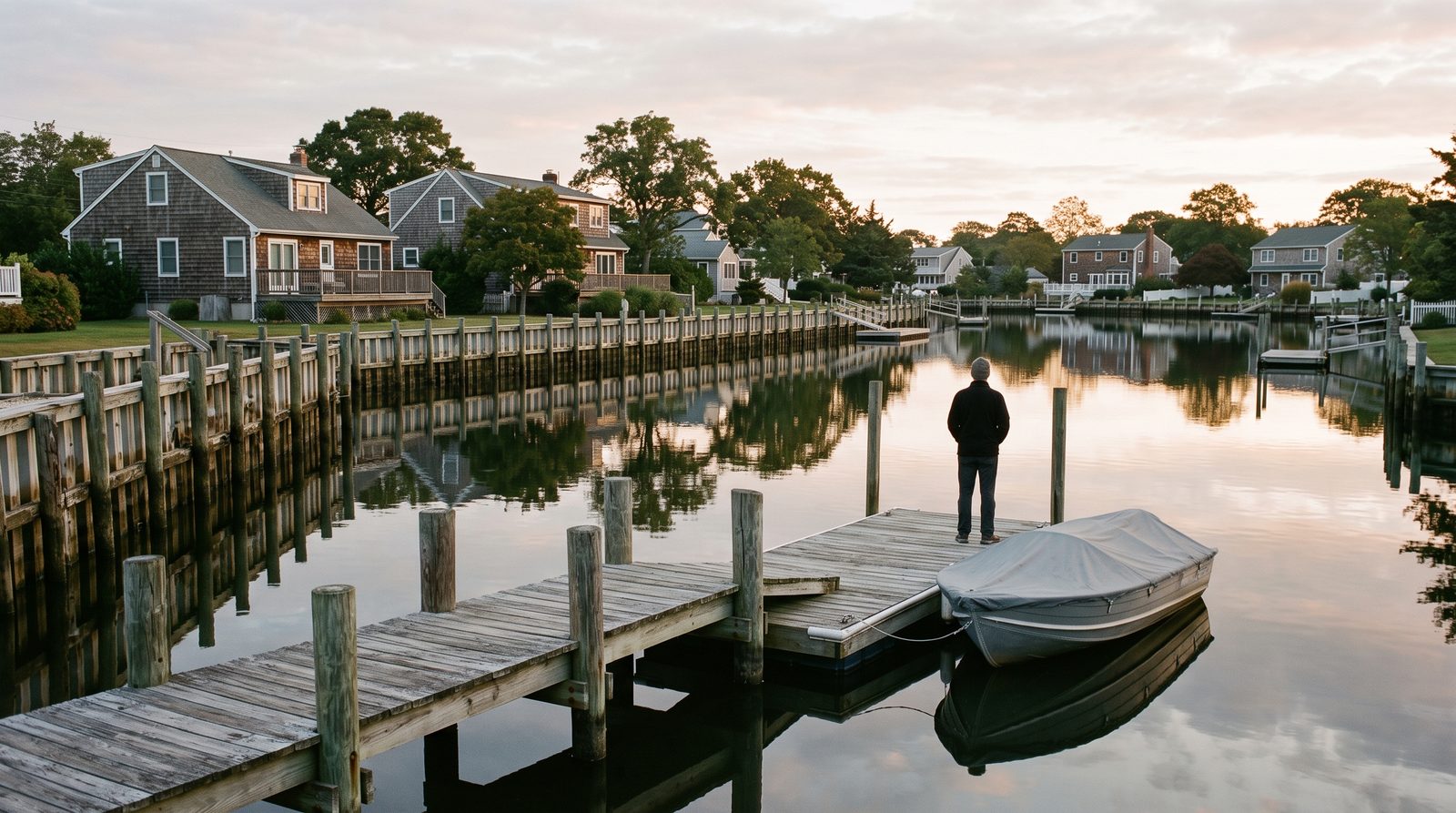
The best dock builder website answers permits first
An NJ dock builder website gets more qualified work by answering the homeowner's first real question: what can be built here, and which permit route may apply? Explain the difference between a man-made lagoon and open-bay frontage, show comparable projects, ask site-specific intake questions, and set honest permit and seasonal expectations. The homeowner who understands the next step is more likely to contact the contractor who explained it clearly.
This guide is for the owner of a dock, bulkhead, or marine-construction business in Ocean County or Monmouth County, New Jersey, who is deciding whether to buy, rebuild, or fix a website. The goal is not more form submissions from anyone near water. The goal is more inquiries from owners whose site, scope, timing, and access are close enough to the company's work to justify a real conversation.
A dock builder's permit page should explain the decision path, not declare that a visitor's project is approved. New Jersey's coastal rules distinguish regulated settings, structures, and authorization types, while other State and local approvals may still apply. That makes accurate regulatory literacy useful marketing, but only when every page tells the homeowner to confirm the site with NJDEP and the municipality.
New Jersey's coastal permit routes
New Jersey's coastal permit landscape begins with NJDEP, not with a contractor's standard dock design. CAFRA supplies the coastal-area framework, while the Coastal Zone Management Rules also implement the Wetlands Act and Waterfront Development Law. A waterfront project can therefore require attention to more than one jurisdictional question even when the proposed structure looks ordinary.
A general permit-by-certification and a general permit are different procedures. Under N.J.A.C. 7:7-3.3, a qualifying permit-by-certification activity may proceed after the online submission produces automatic authorization; a general permit activity requires NJDEP authorization. A project that does not fit an exemption or available standardized route may need a Waterfront Development, coastal wetlands, or CAFRA individual permit, depending on the site.
The permit comparison below is a website planning map, not a permit determination. Exact location, legal status of the old structure, dimensions, wetlands, shellfish habitat, navigation, tidelands interests, and related work can change the route. A dock builder should invite the homeowner to gather facts, then confirm the route with NJDEP and the municipality before work or scheduling commitments begin. This is information, not legal or permitting advice.
| Project | Typical permit route | What the homeowner should expect |
|---|---|---|
| Replacing an existing dock in a man-made lagoon | A same-location, same-size exemption may apply to a qualifying legally existing structure; otherwise a lagoon general permit-by-certification, general permit, or individual review may be needed. | Provide the address, old permit or map evidence, photos, and existing and proposed dimensions. Pre-existing does not automatically mean exempt. |
| A new dock on open-bay frontage | The man-made-lagoon route does not apply. Site review may lead to a Waterfront Development individual permit when no exemption or other coastal authorization fits. | Expect NJDEP to evaluate the natural waterway, design, navigation, and applicable special areas. A neighbor's dock does not establish this site's approval. |
| Bulkhead repair versus replacement | Limited same-location and same-size work may qualify for an exemption; qualifying reconstruction may use general permit-by-certification 10 or general permit 10. New bulkheads follow other routes. | Document whether the bulkhead is legally existing and functioning, whether its alignment changes, and whether fill, wetlands, or wave exposure are involved. |
| A boat lift addition | General permit-by-certification 15 or general permit 15 may fit a qualifying recreational lift in a man-made lagoon. Other settings require a separate site review. | Show the lift location, piles, mooring area, property lines, navigation clearance, existing dock, and water body before expecting a route or start date. |
Lagoon frontage changes the answer
A man-made lagoon has a specific regulatory meaning in New Jersey, and that meaning changes the useful answer in the lagoon communities of Brick and Manahawkin. N.J.A.C. 7:7-1.5 defines it as an artificially created linear waterway, sometimes branched, ending in a dead end with no significant upland drainage. A natural waterway does not become a man-made lagoon merely because it was channelized or bulkheaded.
Qualifying recreational docks, piers, pilings, jet ski ramps, and boat lifts on single-family or duplex lots in man-made lagoons can fall within general permit-by-certification 15 or general permit 15. Both rules carry design and siting conditions, so a website should explain the category without reducing it to a promise that every lagoon project is automatic. The correct content asks enough questions to test the category.
Open-bay, inlet, river, and oceanfront sites need their own content because the lagoon-specific route cannot simply be copied over. Bayfront exposure, wetlands, shellfish habitat, navigation, and water depth can change the design or review. On a lot with frontage on both a man-made lagoon and a natural waterway, the recreational dock rule generally directs the dock to the lagoon unless that location would conflict with other requirements.
A legally existing pre-1981 dock, pier, bulkhead, or qualifying seasonal structure may be treated differently when replacement stays in the same location and size and the required map or permit history exists. Bulkhead reconstruction has separate permit-by-certification and general-permit rules, and a tidelands grant, lease, or license may still be needed where the State holds an interest. Permit approval does not itself erase a separate tidelands obligation.
The project gallery should classify the water body
A dock builder project gallery should be organized by water body and scope, not as one stream of attractive waterfront photos. Useful filters include man-made lagoon dock, open-bay pier, bulkhead reconstruction, boat lift addition, and storm repair. Each project should name the municipality, describe whether the structure was new or existing, state the access method, and avoid implying that one permit result guarantees another.
A service-area page should explain why the company's working area is shaped the way it is. Brick lagoon access can support a different staging plan from a Manahawkin job that requires coordination across to Long Beach Island, where barrier-island access for equipment, materials, or a barge can affect the job. Bayfront and oceanfront exposure also call for different proof than a protected lagoon project.
A permitting FAQ should use short, dated answers with links to the controlling rule, then show the next factual question. If the current site looks polished but produces few calls, use /blog/contractor-website-not-getting-leads/ to audit the whole lead path. An owner comparing rebuild scopes can use /blog/website-cost-nj/ to separate setup work from continuing site care.
A dock builder website rebuild should end each relevant project and permit page with one concrete path: submit the waterfront facts for review, request a call, or start at /claim/. The call to action should say what happens next, such as a scope check before any site visit or estimate. That promise is narrow enough to keep and useful enough to move a qualified visitor forward.
What should a dock builder quote form ask?
A dock builder quote form should qualify the waterfront before asking the office to price the project. Start with property address and municipality, then ask whether the frontage is a man-made lagoon, open bay, river or creek, inlet, or oceanfront. Include an unsure option because the legal definition is not always obvious from what the homeowner calls the waterway.
The form should separate a new structure from repair, same-size replacement, expansion, or relocation of an existing structure. Ask about the dock, pilings, boat lift, bulkhead condition, and any dredging or fill in the requested scope. Invite uploads of current photos, a survey, an old permit, and tidelands paperwork, but do not require documents a first-time visitor may not have.
Access questions protect both the lead and the estimator's time. Ask whether machinery can reach the yard, whether work is likely to require water access, whether the property is on a barrier island, and whether a seasonal tenant or property manager controls entry. The confirmation message should say that the submission starts a scope review, not a permit decision, firm price, or construction reservation.
- Property address, municipality, and the homeowner's description of the water body.
- Existing structure, new structure, repair, replacement, expansion, or relocation.
- Dock, pile, lift, bulkhead, dredging, and fill elements included in the request.
- Bulkhead condition, available yard access, water access, and barrier-island logistics.
- Desired use and timing, plus photos, surveys, prior permits, or tidelands documents if available.
Seasonality starts with the permit, not the crew
Jersey Shore dock scheduling starts when a qualified inquiry arrives, not when a crew first reaches the water. A spring lead may still need site classification, drawings, supporting documents, NJDEP authorization, municipal confirmation, material planning, and access coordination. A website that says so can preserve the lead without pretending that every project can be built before summer.
New Jersey's rule gives NJDEP a decision period of 90 calendar days after a general-permit application or a Waterfront Development or coastal wetlands individual-permit application is declared complete for review. That is not a universal lead-to-construction timeline: gathering a complete submission, revisions, other approvals, tidelands instruments, and permit conditions can sit outside that window. Permit-by-certification follows a different process.
Nor'easters and coastal storms can create a burst of damaged bulkhead, piling, and dock inquiries, but emergency demand does not make the ordinary permit analysis disappear. Ice and winter conditions can damage pilings and floating docks, while wind, tides, bayfront or oceanfront exposure, and barrier-island access can narrow workable days. The website should describe those constraints without publishing one fixed in-water season for every permit and site.
A seasonal follow-up sequence should mark the real stage of the lead: site facts received, route being confirmed, application materials in progress, authorization received, or construction scheduling. For a summer rental, the sequence should also confirm who can authorize access and when occupants change over. Clear stage updates keep a delayed but viable project from being mistaken for a dead lead.
Is the website attracting the right dock jobs?
A dock builder website should be measured by qualified waterfront inquiries, not traffic alone. Record the landing page, water-body type, municipality, project type, existing-versus-new status, access fit, and whether the inquiry reached a site review, estimate, permit stage, booked job, and completed job. Those stages show whether regulatory content is attracting viable work or merely broad research visits.
The first useful comparison is lagoon pages versus natural-water pages, followed by dock, lift, and bulkhead scopes. A high number of unsuitable open-bay inquiries on a lagoon-focused page means the distinction is unclear. A high number of qualified forms that never receive a prompt scope call points to follow-up, not a need for more traffic.
Permit content needs an owner, a review date, and a correction process because rules and agency procedures can change. If the business is difficult to find in local search even after the site answers the right questions, use /blog/business-not-showing-on-google/ to check the separate visibility problem. The website and search listing should use the same real service area rather than claiming every waterfront town from Sandy Hook to Cape May.
Frequently asked questions
These dock builder website answers give Ocean County and Monmouth County owners a careful starting point for common permit and marketing questions. Every property and scope still needs confirmation from NJDEP and the municipality before the content is used to plan or promise work.
Does every New Jersey dock project need an NJDEP permit?
Dock construction or alteration at or waterward of mean high water is generally regulated, but a specific exemption may apply to some legally existing structures replaced in the same location and size. Other projects may fit a permit-by-certification, general permit, or individual permit. Confirm the exact property, structure history, and scope with NJDEP and the municipality.
Is a bulkheaded creek a man-made lagoon?
Not automatically. New Jersey's definition says a natural waterway does not become a man-made lagoon merely because it was filled, channelized, or bulkheaded, and a bulkheaded boat slip is not a lagoon. Use the address and site facts to confirm the classification rather than selecting a permit route from appearance alone.
Can a dock builder promise a construction date before permit review?
A contractor can explain its intake and planning sequence, but a firm construction promise should account for the required authorization, municipal steps, tidelands issues if any, permit conditions, materials, weather, water access, and crew availability. The website should give stage-based updates instead of presenting a spring inquiry as a guaranteed early-summer start.
What should a homeowner send with a dock inquiry?
Send the property address, municipality, a description of the water body, current photos, requested work, existing dock and bulkhead condition, and access constraints. Include a survey, prior permit, or tidelands document if available. Those facts help the builder screen the scope, but they do not replace an NJDEP or municipal determination.